

Alina TEODORESCU
Poland’s PGE named EU ETS’ biggest corporate emitter for third consecutive year
Coal-fired utilities dominate the top three spots in the EU ETS emissions rankings
25 June 2026
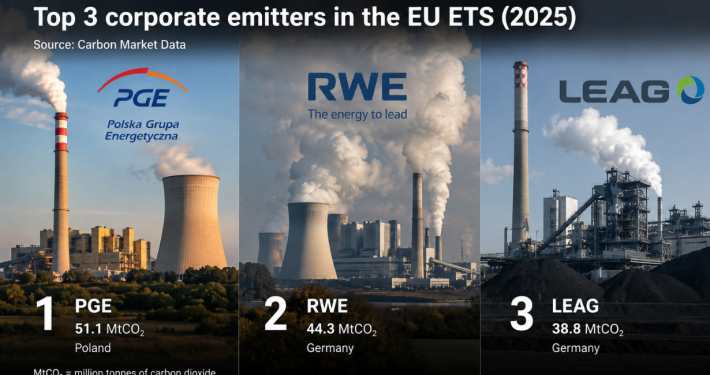
Polish utility PGE (Polska Grupa Energetyczna) remained the largest corporate emitter under the EU Emissions Trading System (EU ETS) last year, according to the latest Carbon Market Data rankings. The company has held the top spot for the past three years and has consistently ranked among the three largest corporate emitters covered by the EU ETS since 2017.
PGE emitted 51.1 million tonnes (Mt) of CO₂ last year, down from 53.6 Mt in 2024 and 56.3 Mt in 2023. While the figures point to a steady year-on-year decline in emissions, the pace of reduction remains relatively modest.

The main driver of PGE’s carbon footprint is the Bełchatów Power Plant in central Poland. The lignite-fired facility is the highest-emitting industrial installation covered by the EU Emissions Trading System and accounts for the largest share of the company’s emissions.
PGE topped the latest Carbon Market Data rankings, followed by Germany’s energy giants RWE and LEAG. RWE remained in second place after reducing its emissions by 2.2 million tonnes of CO₂ (MtCO₂) year on year to 44.3 MtCO₂, while LEAG ranked third with emissions of 38.8 MtCO₂.
Since 2018, RWE has reduced its emissions by nearly 63%, compared with a decline of around 25% at PGE, allowing the Polish utility to overtake the German company as the bloc’s largest corporate emitter.
However, RWE’s emissions profile has changed markedly over the past decade as the company has transformed from a coal-focused utility into a diversified energy group with major investments in offshore and onshore wind, solar, battery storage, flexible gas-fired generation and electricity networks. Despite this transformation, its remaining lignite-fired power plants continue to rank among the largest individual sources of carbon emissions under the EU ETS.

